Many travellers ask themselves whether bringing a personal seat belt extender on a flight is a good idea. That’s especially true if you have needed one before and want to avoid the discomfort of asking cabin crew mid-flight. The honest answer is that it depends on the regulations of the aviation authority governing your flight, and those rules are stricter than most people expect. Both the Federal Aviation Administration in the US and the UK Civil Aviation Authority have specific requirements around seat belt extenders, and understanding them before you travel can save you significant embarrassment at the gate. We break down exactly what the FAA and CAA say, and what UK travellers need to know before packing a personal extender.
What Role Do the FAA and CAA Play in Regulating Seat Belt Extenders?
The FAA and CAA are the governmental bodies responsible for civil aviation safety in the United States and the United Kingdom, respectively. Their remit covers everything that affects passenger and crew safety in the air, from aircraft structural design down to the smallest cabin equipment, including seat belts and any device that interfaces with them. A seat belt extender used on an aircraft is not a personal accessory in the eyes of either authority. It is aviation safety equipment, and it is regulated accordingly. Any extender used on a commercial flight must meet the certification requirements of the relevant authority, regardless of where it was purchased or what it is certified for on the ground.
Why Do Aviation Regulations Apply to Seat Belt Extenders Specifically?
Every piece of equipment used on a commercial aircraft must be certified as airworthy, and that includes seat belt extenders. A road-certified extender has been tested to ground-level crash standards, not aviation ones, and the two are fundamentally different environments with different failure modes.
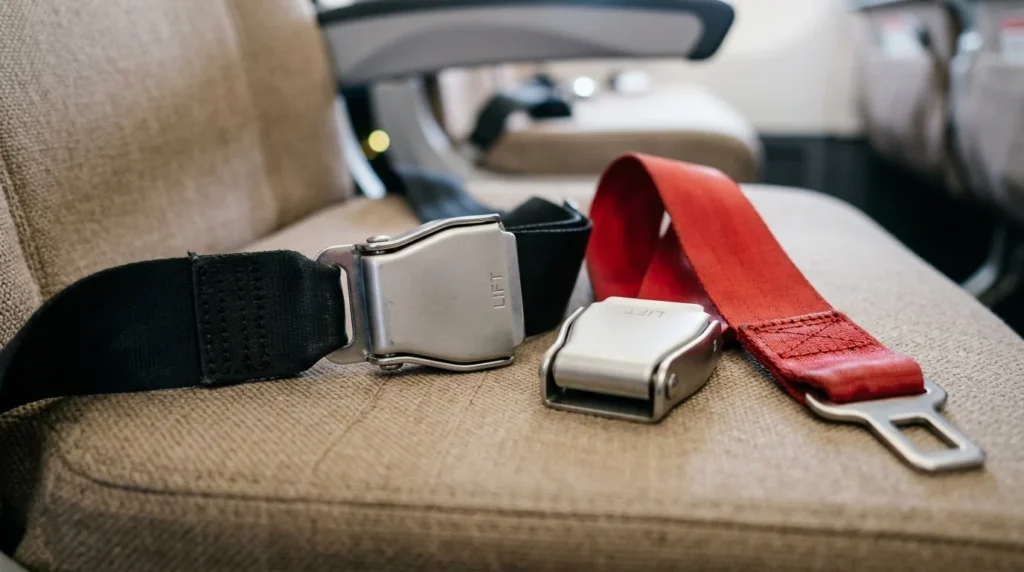
Aircraft seat belt buckles use a completely different latch and release mechanism from car buckles. A road-certified extender may appear to fit but will not engage correctly under aviation emergency conditions.
Aviation certification confirms three things that ground certification does not:
Meets Aviation Design Standards: The extender must be manufactured to FAA or CAA engineering specifications, including fire resistance ratings, since cabin fires are a real evacuation risk, and specific tensile strength requirements for the rapid deceleration forces experienced in an emergency landing rather than a road collision.
Performs Under Operational Conditions: Aircraft experience turbulence, hard landings, and rapid depressurisation events that place very different demands on restraint equipment than road use. An extender that holds under a car crash may behave unpredictably under repeated aviation stress cycles.
Compatible With Aircraft Buckle Systems: Aircraft seat belt buckles use different tongue widths, latch mechanisms, and one-handed release systems designed for rapid evacuation. A road extender may appear to fit but engage the latch incorrectly, creating a connection that holds under light load but releases under the forces of an emergency stop or impact.
Airlines control which extenders are permitted onboard because a failed or incompatible extender does not just risk injury. It can also physically impede a passenger’s ability to evacuate within the 90-second window that aviation safety standards are designed around.
What Is the FAA and CAA Position on Personal Seat Belt Extenders?
Both the FAA and CAA strongly advise against passengers using privately owned seat belt extenders on commercial flights. The position comes down to the fact that no personal extender purchased by a passenger carries the aircraft-specific certification required to guarantee it will perform safely in an aviation emergency.
Airline-Provided Extenders Are the Standard: Every commercial airline operating under FAA or CAA oversight is required to carry seat belt extenders that are specifically certified for their aircraft type. These extenders are tested as part of the aircraft’s safety equipment approval. They are not generic products but components matched to the exact buckle design, seat configuration, and evacuation requirements of that specific aircraft.
Personal Extenders Cannot Be Certified for Airline Use: The FAA and CAA do not operate a process by which individual passengers can have their personal extenders approved for commercial aviation use. Even an extender purchased from a reputable aviation supplier and marked as FAA-compliant may only be certified for specific aircraft types, and it is the airline’s responsibility, not the passenger’s, to confirm compatibility.
Final Authority Rests With the Crew: The pilot-in-command has ultimate authority over what equipment is used on their aircraft. Cabin crew is trained to identify and remove uncertified safety equipment, and a personal extender presented by a passenger will almost certainly be declined, regardless of where it was purchased or what markings it carries.
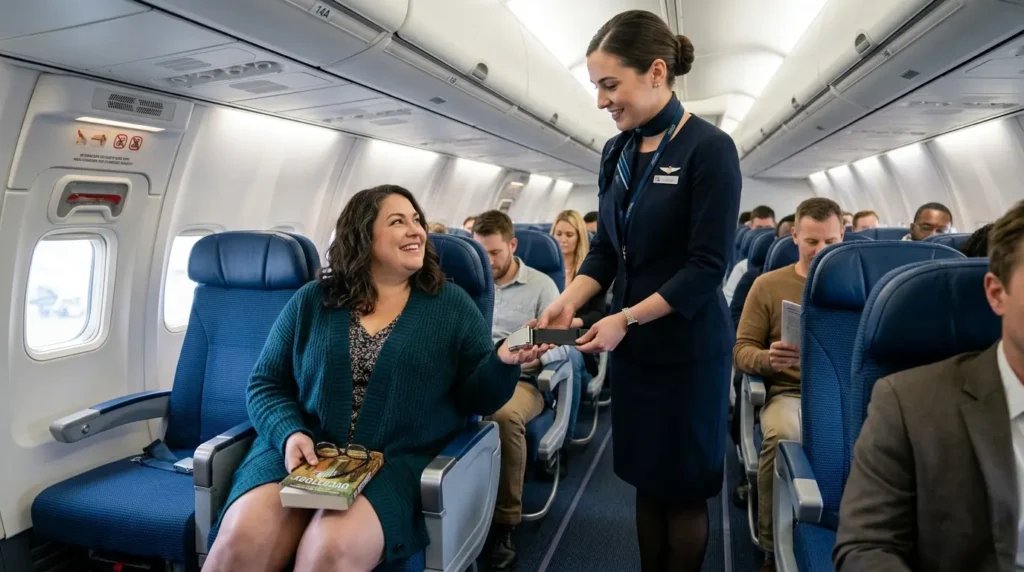
Requesting a seat belt extender from cabin crew is a routine and discreet process. The extender provided is certified for that specific aircraft and guaranteed to fit correctly.
What Does This Mean for UK Travellers?
For passengers flying from, to, or within the UK, whether on a UK carrier or an international airline operating under CAA or FAA jurisdiction, the practical implications are straightforward:
Do Not Rely on a Personal Extender: Bringing your own extender is a risk that rarely pays off. Cabin crew can and routinely do decline personal extenders at boarding or during the safety check. If you cannot be safely secured without one and the airline’s extender does not fit your harness attachment, the consequences can range from significant discomfort to being unable to travel on that flight.
Request One From Cabin Crew: Asking a flight attendant for a seat belt extender is a routine request that crew handles discreetly and without judgment. The extender they provide is certified for that specific aircraft, guaranteed to fit the buckle, and tested to perform in an emergency. This is always the safest and most reliable approach. Ask before you sit down, if possible, to prevent slow boarding.
Check Your Airline’s Policy Before You Fly: While the general principle is consistent across FAA and CAA regulated carriers, individual airlines do publish their own guidance. Budget carriers in particular may have stricter onboard policies than full-service airlines. Checking in advance means you will not be caught off guard at the gate, and some airlines allow you to flag the request at check-in so a crew member has an extender ready when you board.
Fly Comfortably and Legally. Know the Rules Before You Board
Aviation safety regulations exist for good reason, and seat belt extenders are no exception to them. For passengers on commercial flights, the safest and most reliable approach will always be to request a certified extender from cabin crew. It costs nothing, takes seconds, and guarantees you have a device that meets every safety requirement for that specific aircraft.
For those who own or regularly fly on private aircraft, the situation is different. A privately owned plane does not carry airline-provisioned extenders, which means sourcing your own becomes a genuine necessity. In this case, choosing an extender that is FAA-compliant and specifically designed for aviation use is essential. Do not buy a ground-certified road extender repurposed for the cockpit.
Flying privately and need a certified aviation seat belt extender? Browse our range of FAA-compliant plane seat belt extenders, designed specifically for aviation use, built to the standards that matter in the air, and delivered free across the UK via Royal Mail.
Mr Seatbelt
I'm a huge fan of travelling, and doing so safely. I write articles about seatbelts to help educate our customers. If you have any questions about seat belts, just ask!