Every parent’s priority is the safety of their children in a vehicle or anywhere else. When considering seat belt extenders, many parents wonder, can they be used with child car seats or booster seats? The unequivocal answer, supported by safety experts, manufacturers, and UK road safety authorities, is no. Understanding why this rule exists without exception is essential for every parent and caregiver who transports children in a vehicle. This guide explains exactly why seat belt extenders must never be used with child restraint systems, and what parents need to know to keep their children safe on every journey.
Why Can’t You Use a Seat Belt Extender With a Child Car Seat?
Child car seats are precision-engineered safety systems tested to perform in a very specific way with a vehicle’s original seat belt. Adding an extender to that equation reduces effectiveness and also makes a correctly installed car seat genuinely dangerous in a collision.
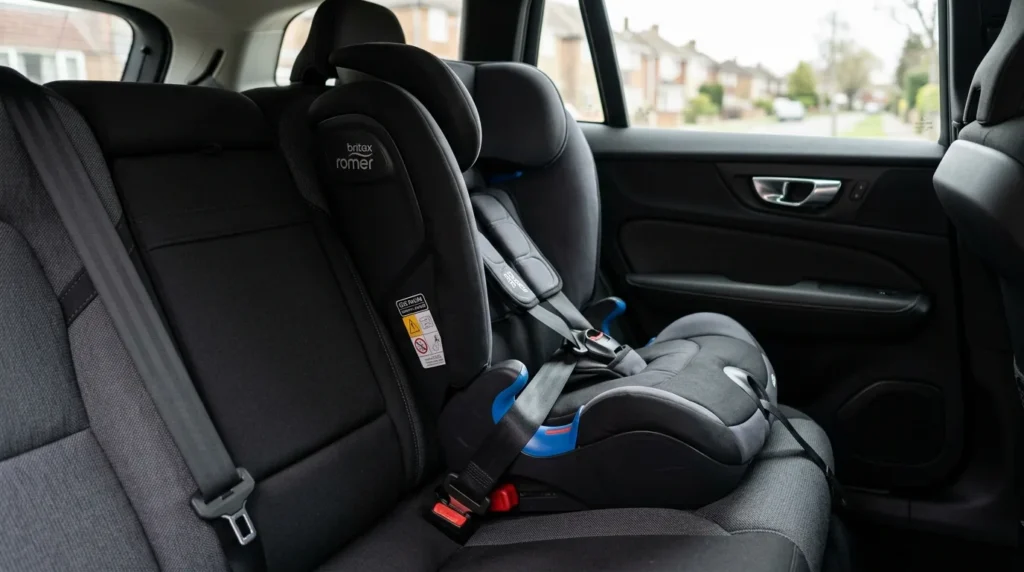
A correctly installed child car seat must be secured with the vehicle’s original seat belt only, pulled tight with zero slack, latched directly into the original buckle, with no extender anywhere in the belt path.
Compromised Fit and Tension: Child car seats must be installed with zero slack in the seat belt. An extender introduces additional length that prevents the belt from pulling the seat tight against the vehicle seat, meaning in a crash, the car seat moves before it restrains, dramatically reducing its protective performance.
Altered Belt Geometry: An extender changes the angle and routing of the seat belt across the child restraint, potentially causing the belt to ride up over the child’s abdomen rather than sitting low across the hips. Abdominal loading in a frontal crash is a leading cause of serious internal injuries in children, including what is clinically known as seat belt syndrome.
Unpredictable Crash Performance: Every child car seat is crash-tested to strict standards without an extender present. The moment an extender is added, the tested configuration no longer exists, which creates an untested combination whose behaviour in a collision cannot be predicted and that no manufacturer or safety authority will certify as safe.
No Certification Exists: No seat belt extender on the market is certified for use with a child restraint system. Car seat manufacturers explicitly state in their instructions that their products must only be used with the vehicle’s original unmodified seat belt, and deviating from those instructions voids the car seat’s safety certification entirely.
What Do Safety Experts Say About Seat Belt Extenders and Child Car Seats?
The position of child passenger safety organisations is unanimous and unambiguous. Seat belt extenders are for adults who cannot buckle up comfortably due to their size and have no place in any child restraint setup. Groups like The Car Seat Lady and equivalent UK child road safety organisations consistently warn that even a well-intentioned workaround can turn a correctly installed car seat into a hazard. If an extender is present anywhere in the seat belt path of a child restraint, the installation is unsafe regardless of how secure it appears.
What Should You Do If the Seat Belt Is Too Short to Install a Child Car Seat?
If your vehicle’s seat belt genuinely cannot reach the buckle point of a child car seat without an extender, the solution is never the extender, but one of these four alternatives:
If your vehicle’s seat belt genuinely cannot reach without modification, a certified car seat technician can assess your installation in person and recommend the right solution. Free checks are available at many UK fire stations and children’s centres.
Try a Different Seating Position: Seat belt lengths vary between seating positions in the same vehicle. Moving the child car seat to a different seat, particularly the centre rear, often resolves the length issue without any modification.
Consult a Certified Car Seat Technician: A trained technician can physically assess your installation, identify whether a length issue is genuine or technique-related, and recommend compatible child car seat models or installation methods for your specific vehicle. In the UK, many fire stations and children’s centres offer free car seat checks.
Consider a Different Car Seat Model: Some child car seat designs use a shorter belt path or a different routing that works with shorter seat belts. A specialist retailer can help you identify models that are known to fit your specific vehicle.
Use ISOFIX: If your vehicle and child car seat both support ISOFIX, this rigid anchor system bypasses the seat belt entirely for installation. This eliminates the length issue completely while providing a more rigid, consistently secure connection than a belt-installed seat.
Is There Any Situation Where a Seat Belt Extender Could Be Used for a Child?
In the vast majority of cases involving children, the answer remains no. However, there is one narrow exception worth addressing honestly. An older child who has genuinely outgrown the need for a booster seat but for whom the adult seat belt still feels uncomfortably tight across the body.
Even in this limited scenario, three conditions must all be met before an extender is considered:
The child meets adult seat belt requirements: UK children can use an adult seat belt without a booster once they reach 135cm in height or their 12th birthday, whichever comes first. Below this threshold, an extender is never appropriate, regardless of how tight the belt feels.
The extender correctly positions the belt: The lap belt must sit low across the hips, not across the abdomen, and the shoulder belt must cross the centre of the chest without cutting into the neck. If an extender cannot achieve this positioning, it must not be used.
A child passenger safety expert is consulted first: This is not a decision a parent should make alone based on online research. A certified car seat technician can assess whether an extender is genuinely appropriate for that specific child’s size, weight, and the vehicle being used, and recommend a certified product if they should.
For any child still using a car seat or booster seat, a seat belt extender is unequivocally unsafe and must never be used under any circumstances.
Put Your Child’s Safety First By Not Using a Seat Belt Extender With a Child Car Seat
The safety of children in vehicles must never be compromised. Seat belt extenders are a valuable tool for adults who genuinely need them, but they pose a significant and well-documented risk when used with child car seats or booster seats. Always follow the car seat manufacturer’s instructions to the letter, and if you encounter genuine installation difficulties, seek hands-on help from a certified child passenger safety technician rather than reaching for a workaround that puts your child at risk.
Need a seat belt extender for an adult passenger? Browse our full range of UK-tested, certified seat belt extenders, designed exclusively for adult use, built to international safety standards, and delivered free via Royal Mail on every order.
Mr Seatbelt
I'm a huge fan of travelling, and doing so safely. I write articles about seatbelts to help educate our customers. If you have any questions about seat belts, just ask!